
The Wildlife of Piha.
A short field guide to what you might see — from the bush to the beach, the stream to the sea.
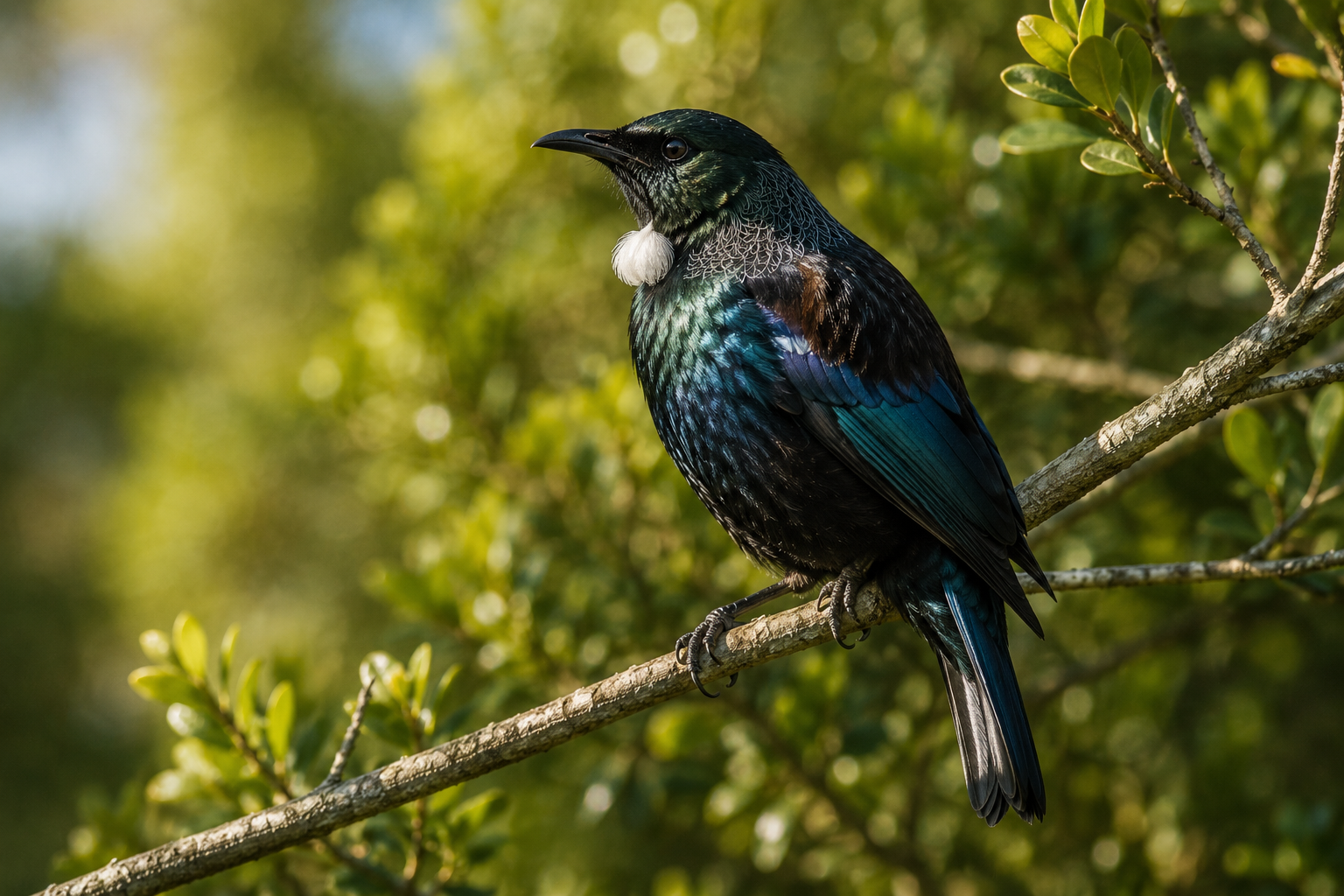
The NZ Tui has a distinctive tuft and beautiful song.
Piha is a small village, but the wildlife around it is anything but.
Behind the beach lie the Waitākere Ranges, a regional park covering more than 16,000 hectares of native forest. In front stretches the Tasman Sea, one of the most dynamic marine environments in Aotearoa. Connecting the two are the waterways that run through Piha — the Piha Stream, Marowhara Stream and Wekatahi Stream — carrying freshwater, nutrients and wildlife between forest, wetland, estuary and ocean.
Together they form a remarkably rich ecosystem. In a relatively small area you'll find native birds, fish, marine mammals, reptiles, insects and countless smaller creatures, many of which are found nowhere else in the world.
Some are easy to spot. Others reveal themselves only if you're patient, quiet and paying attention.
What follows isn't a comprehensive ecological survey. It's simply a field guide to the wildlife most visitors are likely to encounter during a stay in Piha — the creatures that help make this place feel like Piha.
In the bush.
Tūī
The virtuoso singers of the forest, recognised by their iridescent blue-green feathers and distinctive white throat tuft. You'll usually hear them before you see them. Their songs, clicks, whistles and mimicry form part of the soundtrack of a Piha morning.
Kererū (New Zealand Wood Pigeon)
Large and unmistakable, with shimmering green feathers, a white breast and a wingbeat that sounds remarkably like a small helicopter. Kererū are vital seed dispersers for native forest and one of the reasons the bush continues to regenerate.
Pīwakawaka (Fantail)
Small, energetic and endlessly curious. Fantails often follow walkers along tracks, darting through the air to catch insects disturbed by passing feet. They're probably the native bird most likely to introduce itself to you.
Kākā
Large forest parrots known for their intelligence, playful behaviour and unmistakable calls. While less common than tūī or kererū, their noisy flights overhead are a memorable part of spending time in the ranges.
Ruru (Morepork)
The native owl of Aotearoa. You're far more likely to hear one than see one. On quiet evenings, their distinctive call echoes through the valleys after dark.
Brown Kiwi
One of New Zealand's most iconic birds. Kiwi live in the bush surrounding Piha but are rarely seen during daylight hours. If you're lucky, you might hear their calls at night.
Kārearea (New Zealand Falcon)
One of New Zealand's most impressive birds of prey. Fast, powerful and highly skilled hunters, they are occasionally seen above the ranges and coastal forest.
Kāhu (Australasian Harrier)
Commonly seen soaring on thermals above open areas and along the coastline, scanning the landscape below.
Native Frogs
The Waitākere Ranges are home to Hochstetter's frog, one of the most ancient frog species on Earth. Tiny, well-camouflaged and rarely encountered, they are a reminder of just how old these ecosystems are.
Geckos and Skinks
Several native lizard species live throughout the ranges. Most are shy and quick to disappear into vegetation or rock crevices, but patient observers occasionally spot them basking in the sun.
Wētā
Large, prehistoric-looking insects that have survived virtually unchanged for millions of years. Despite their intimidating appearance, they're harmless and fascinating examples of New Zealand's unique evolutionary history.
Glowworms
In damp gullies and stream banks, tiny glowworms sometimes illuminate the darkness like scattered stars. They're easy to miss, but magical when found.
In the bush
Alongside tūī, kererū, pīwakawaka and kākā, keep an eye out for: Miromiro (Tomtit)Tauhou (Silvereye / Waxeye)Matatā (Fernbird). These smaller native birds are easy to miss but reward patient observation.
At the beach and offshore
The ocean beyond Piha often appears wild and empty. In reality, it supports an extraordinary range of marine life.
Māui Dolphins
The world's rarest marine dolphin and one of New Zealand's most endangered species. They live only along the west coast of the North Island. Sightings are rare and special. Learn more
Common Dolphins
More frequently seen than Māui dolphins, often travelling in playful pods offshore. Cliff-top lookouts are one of the best places to scan for them.
Orca
Visitors are often surprised to learn that orca regularly travel along Auckland's west coast. While sightings are infrequent, they do occur and are unforgettable when they happen.
Whales
Bryde's whales, humpbacks and other migrating whale species occasionally pass offshore during seasonal movements.
Kororā (Little Penguin)
The world's smallest penguin nests along parts of the coastline and returns ashore under cover of darkness. If you're fortunate enough to encounter one, keep your distance and avoid shining lights directly at it.
Kekeno (New Zealand Fur Seal)
Occasionally seen resting on rocks around Lion Rock and the southern headland. They may look relaxed, but they're powerful wild animals and should never be approached.
Seabirds
Piha's coastline hosts a wide variety of birdlife. Oystercatchers patrol the shoreline, terns and gannets plunge-dive for fish, and gulls wheel above the surf searching for opportunities.
In the stream and freshwater
The streams of Piha connect the forest to the sea, carrying nutrients, fish and life between the two.
Tuna (Longfin Eels)
Long-lived native eels inhabit the stream and the pools around Kitekite Falls. Some may be decades old. In te ao Māori they are regarded as taonga species with deep cultural significance.
Īnanga and Other Galaxiids
Small native fish that migrate between fresh and salt water. Their young are collectively known as whitebait and are part of a long New Zealand fishing tradition.
Kōura (Freshwater Crayfish)
Found in clean bush streams, kōura hide beneath rocks and submerged debris. Spotting one requires patience and a careful eye.
Mullet and Kahawai
In the lower reaches of streams and estuaries, fish move between ocean and freshwater environments, highlighting how connected these ecosystems really are.
On the rocks and in the rock pools
One of the joys of Piha is that so much wildlife is visible without needing binoculars or specialist knowledge. A child with wet feet and a bucket can spend hours exploring the rock pools at low tide.
Please leave them exactly as you found them. Shells, crabs, starfish, anemones and the countless smaller creatures living between the rocks all play a role in the ecosystem. If you lift a rock, replace it carefully. If you find something interesting, photograph it rather than taking it home.
Leave the rock pools for the next family to discover.
At low tide, the coastline becomes a miniature world of its own.
Pāua
New Zealand's famous abalone. Found on rocky reefs and protected by strict catch limits.
Kina
Dark, spiny sea urchins common in shallow reefs and rock pools.
Crabs, Anemones, Starfish, Limpets and Snails
The familiar residents of the intertidal zone. Spend an hour exploring rock pools with a curious child and you'll quickly realise how much life exists in a space no bigger than a dinner plate.
Octopus and Moray Eels
Rarely seen but present among the reefs and rocky crevices along the coast.
After dark
As daylight fades, a different group of wildlife emerges.
Oi (Grey-faced Petrel)
These ocean-going seabirds return to nesting burrows after dark. Their haunting calls are one of the lesser-known sounds of the west coast.
Ruru (Morepork)
The familiar voice of the New Zealand night forest.
Pēkapeka-tou-roa (New Zealand Long-tailed Bat)
One of only two surviving native bat species in New Zealand and our only native land mammal. They are present within parts of the Waitākere Ranges but are rarely seen due to their nocturnal habits.
The wildlife we manage
Not everything in the Waitākere ecosystem evolved here.Several introduced species have had devastating impacts on native wildlife and remain the focus of ongoing conservation efforts.
Possums
Introduced from Australia and highly destructive to native forest.
Rats
One of the greatest threats to native birds, reptiles and insects.
Stoats
Highly effective predators responsible for significant declines in native bird populations.
Hedgehogs
Charming to look at, but surprisingly harmful to ground-nesting birds and native invertebrates.Across the ranges, volunteers, community groups, Auckland Council and the Department of Conservation work together to control these pests and restore habitat for native species. Predator-control programmes have helped kiwi, kākā, ruru and many other native species reclaim parts of the forest where they were once struggling to survive. Learn more:
A note on sharing space
The wildlife here isn't performing for us. The dolphins aren't there to be approached. The seals aren't there to pose for photographs. The eels in the stream aren't there to be fed. Even seemingly harmless actions can change animal behaviour and create risks for both wildlife and people.T he best wildlife encounters are usually the quietest ones. You keep your distance, stay still, pay attention and get lucky. If you're interested in wildlife, slow down.
The people who see the most in Piha are rarely the people covering the most ground. They're the ones who stop, sit quietly and let the landscape reveal itself.
One final request: clean your boots before and after every bush walk. Kauri dieback is threatening the giant trees that support this entire ecosystem, and the disease spreads through contaminated soil. The cleaning stations at track entrances exist for a reason. Please use them every time. Learn more
The bush isn't ours. The ocean isn't ours. We're guests in both, and the wildlife is part of what makes Piha what it is.
